

An international research consortium has experimentally demonstrated that altermagnets can serve as sources of spin current, unveiling a first-of-its-kind spintronic functionality in magnets with zero net magnetization. This breakthrough opens exciting avenues towards smaller, faster, and more energy-efficient next-generation spintronic devices.

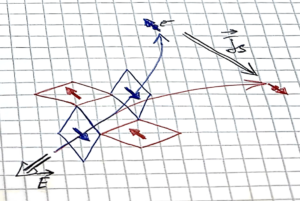
Schematic illustration of the spin-splitter effect in an altermagnet, consisting of two collinear, antiferromagnetically coupled magnetic sublattices with anisotropic spin densities, represented by rhombus. Upon application of an electric field E, a transverse spin current JS is generated.
Altermagnetism combines an unconventional set of properties characteristic of both ferromagnets and antiferromagnets. Despite exhibiting zero net magnetization, altermagnets can host spin-dependent transport phenomena, including spin-current generation. This capability originates from the breaking of time-reversal symmetry, which, through nonrelativistic spin physics, gives rise to an alternating spin splitting of the electronic bands. This distinctive electronic structure is rooted in the real-space arrangement of the magnetic sublattices: although antiferromagnetically coupled, they are not equivalent, with their spin-density distributions elongated along different spatial directions.
Manganese silicide (Mn₅Si₃) is one of the rare altermagnets experimentally demonstrated to date. It has been extensively investigated and optimized within a consortium involving SPINTEC, which has developed unique expertise in the delicate understanding of this material. In particular, the Marseille partner at CINaM has mastered the growth of high-quality Mn₅Si₃ thin films by molecular beam epitaxy, providing the consortium with privileged access to this challenging material. Demonstrating its potential for spintronic functionality was therefore a natural next step. Using a lateral spin-valve device, the consortium, in a study led by its Spanish (CIC NanoGUNE) and Czech (FZU) partners, experimentally demonstrated spin-current generation in Mn₅Si₃, with an efficiency comparable to that of conventional ferromagnets. Importantly, they established that this spin current originates from the spin-splitter effect, a mechanism specific to altermagnets among magnetic materials, in which a transverse spin current is generated perpendicular to the charge-current flow.
Building on this achievement, the consortium is pursuing several research directions: uncovering the microscopic origin of altermagnetism in Mn₅Si₃, controlling its amplitude and achieving on/off switching, and investigating the anisotropy of spin-current generation as a route to new spintronic functionalities. Further efforts focus on industry-compatible growth processes and identifying conductive altermagnets operating at room temperature, bringing altermagnetic spintronics closer to practical applications.
Teams: Antiferromagnetic Spintronics
Collaboration: CIC NanoGUNE – CFM (SP), CINaM (FRA), JGU – TUD – MPI (GER), FZU – Charles Uni. (CZECH)
Funding: HEXAS ANR-24-CE92-0038-02, PEPR SPIN SPINMAT ANR-2-EXPSP-0007, PEPR SPIN ALTEROSPIN ANR-24-EXSP-0002.
Further reading: Time-reversal-symmetry-breaking spin injection from a compensated magnet, J. Mencos et al., Nature 659, 69 (2026); https://doi.org/10.1038/s41586-026-11227-7
Open access: hal-05430429
Contact: Vincent Baltz