

Spin waves are propagating fundamental excitations of magnetic systems, also carrying promises for low-power logic and data transfer. We report the measurement of thermal spin-wave spectra in single cylindrical nanowires, and their quantitative analysis as modes with a radial and azimuthal index. This opens the route for more elaborate investigations including generation, manipulation and detection.

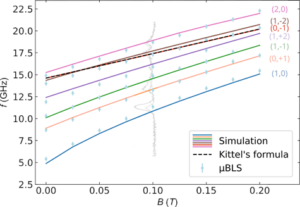
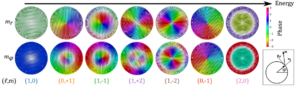

Spin waves (or magnons, their particle-like counterpart), are a collective oscillation of magnetization vectors in a ferromagnet, either thermal or resulting from an excitation. Until now, their physics and potential for device functionality have been probed mostly in either bulk crystals or thin films and circuits. In parallel, theory has outlined new physics to be expected in 3D nanosystems, related to finite-size and curvature, such as quantization and non-reciprocity. In order to confirm this new physics and unlock its potential for 3D devices, a first milestone is their measurement and modelling in individual conduits.
We have considered cylindrical wires of about 100 nm in diameter made of Fe20Ni80, the prototypical soft-magnetic material, displaying homogeneous and longitudinal magnetization. These were synthesized with electroplating in anodized alumina porous templates, the latter ultimately dissolved chemically. Individual wires were laid on a Si surface and measured with micro-Brillouin Light Scattering (µBLS), a technique that probes an area below a micrometer squared and spin waves with wave vector k up to roughly 40 rad/μm. Spectra of thermal spin waves (i.e., existing at room temperature without the need for excitation by a device) were measured versus applied longitudinal field for better discrimination. Up to seven peaks were measured for each value of applied field, which we could fit globally with a single set of two magnetic parameters (magnetization and exchange stiffness) using the open finite-element modeling code TetraX (see figure). Every mode is associated with a set of radial l and azimuthal m indexes, which relate to the number of nodes of the radial mr and mφ components of the dynamic magnetization. Similar to standing spin waves in thin films, this allows a precise determination of exchange stiffness of the material.
This first measurement and quantitative understanding of spin waves in individual cylindrical nanowires paves the way for the exploration of both exciting physics and related applicable functionalities. This includes the non-reciprocity of spin waves for peculiar 3D magnetization distributions, such as with an azimuthal component, and their coupling with domain walls, chemical modulations or branching.
Team: Spin Textures
Collaborations: Universidad Complutense (Madrid), C2N & LPS (Paris-Saclay)
Further reading: Experimental determination and micromagnetic analysis of spin wave modes in cylindrical nanowires, N. Martin, L. Alvaro-Gomes, L. Perez, A. Thiaville, J.P. Adam, O. Fruchart & A. Masseboeuf, Phys. Rev. B, 113 (13), 134423 (2026). Open access: hal-05231476
Open access: cea-05003501v1 and cea-05003507v1
Contact: Olivier Fruchart and Aurelien Masseboeuf