


Van der Waals magnets are typically limited to low-temperature and multilayer form. Here, we first demonstrated room-temperature ferromagnetism in thicker Co-doped Fe₅GeTe₂ films, then achieved ferromagnetism up to ∼200 K in epitaxial monolayers, a breakthrough for two-dimensional spintronics.

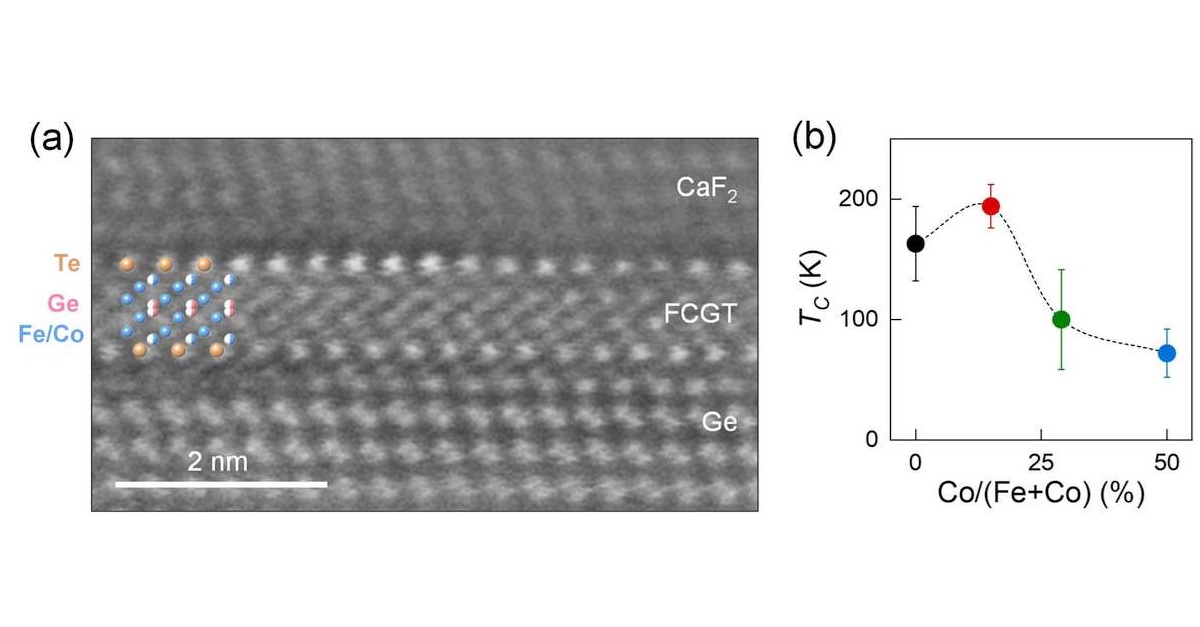
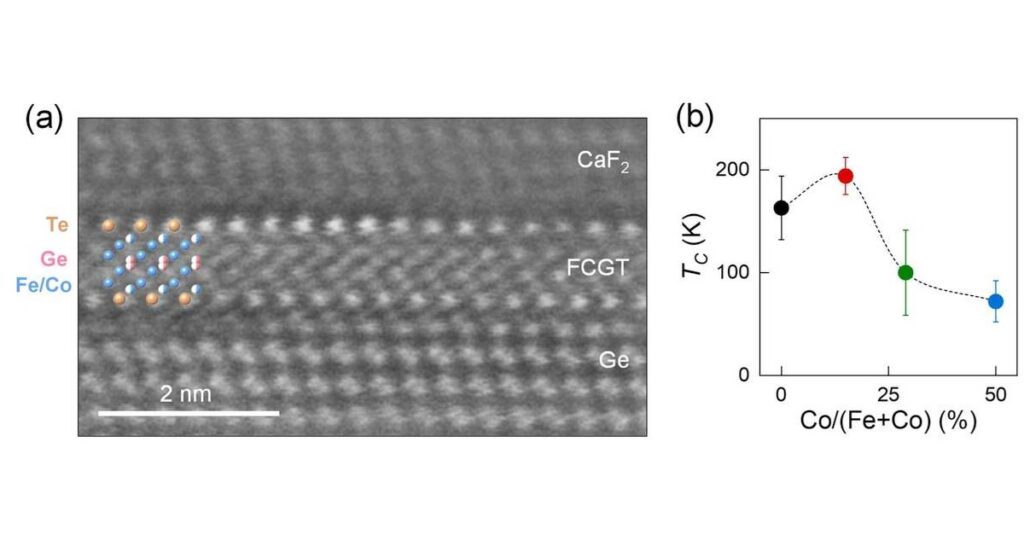
(a) Atomically resolved image of an FCGT monolayer by scanning transmission electron microscopy. (b) Variation of the Curie temperature as a function of the Co content. A maximum is observed when one in five Fe atoms is replaced by Co.
Two-dimensional (2D) van der Waals (vdW) magnets are highly sought after for their potential in spintronics. Their 2D nature could enable building ultracompact devices with sharp interfaces at the atomic level, leading to enhanced and tunable spintronic functionalities. However, these materials are mostly studied in the form of micrometric flakes exfoliated from bulk crystals, with little control on their thickness and lateral dimensions. Therefore, developing methods able to fabricate atomically thin layers on large areas has become critical. Moreover, achieving long-range magnetic order in true monolayers has remained a significant challenge, as vdW magnets generally exhibit Curie temperatures (TC) well below room temperature in their thinnest form.
Our work began by successfully synthesizing Co-doped Fe₅GeTe₂ (FCGT) multilayer films on centimeter-scale areas using molecular beam epitaxy. These films exhibited ferromagnetism well above room temperature, up to ∼370 K. Building on this, we then focused on the strictly 2D regime, growing monolayers of FCGT on Ge(111) substrates. For an optimum concentration in Co, these monolayers demonstrated ferromagnetism up to ∼200 K, a record for 2D vdW magnets.
In order to understand the origin of the TC enhancement, we performed synchrotron experiments that allowed us to resolve the magnetic moments on Fe and Co atoms separately, with a technique called X-ray magnetic circular dichroism (XMCD). Surprisingly, these measurements revealed that the Co dopants responsible for the increase in TC were only weakly magnetic. Our density functional theory calculations confirmed this observation. They also showed that, despite their weak magnetic moment, the Co dopants strengthen those of neighboring Fe atoms and locally boost the magnetic exchange interaction, in good agreement with XMCD observations.
The good news is that Co dopants substitute Fe atoms instead of intercalating in the vdW gaps. This means that Co doping is able to enhance the TC whatever the thickness of the material, even in ultimately thin 2D layers. This work not only improved our understanding of these novel materials but also opened new avenues for integrating 2D magnets into complex spintronic devices by epitaxial growth.
Teams: Topological spintronics, Theory and simulation
Collaboration: ESRF, SOLEIL, IRIG-MEM
Funding: ANR (ELMAX, NEXT), FLAG-ERA MNEMOSYN, PEPR SPIN (SPINMAT)
Further reading: High Temperature Ferromagnetism in Epitaxial Monolayers of Co-doped Fe5GeTe2, J. Courtin, F. Ibrahim et al., Phys. Rev. Lett. 137, 046703 (2026).
Open access: hal-05682327
Contact: Frédéric Bonell and Mairbek Chshiev