
Research team Theory/Simulation, within the Concepts group
Dzyaloshinskii-Moriya interaction chirality reversal with ferromagnetic thickness (September 04th, 2026)

In Ta/FeCoB/TaOx, it was demonstrated that the Dzyaloshinskii-Moriya interaction (DMI) chirality can undergo modification solely in response to variations in the thickness of the ferromagnetic layer. This inversion of chirality is attributed to variations in orbital filling and interatomic distances at the interface, driven by the structural relaxations in the ultrathin regime. This method provides […]
Read moreHigh-temperature ferromagnetism in 2D (August 28th, 2026)
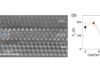
Van der Waals magnets are typically limited to low-temperature and multilayer form. Here, we first demonstrated room-temperature ferromagnetism in thicker Co-doped Fe₅GeTe₂ films, then achieved ferromagnetism up to ∼200 K in epitaxial monolayers, a breakthrough for two-dimensional spintronics. Two-dimensional (2D) van der Waals (vdW) magnets are highly sought after for their potential in spintronics. Their […]
Read moreOpening Postdoctoral Position: New Paradigms in Spintronic Fluctuations (July 23rd, 2026)

Position: The project FLUSPIN is opening a 12-month position (possible extensions) for a postdoctoral researcher to explore the integration of Kramers-type thermal activation theories—validated for equilibrium conditions in superparamagnetic systems—with a functional calculus approach. This approach extends the Fokker-Planck equation (FPE) to magnetization dynamics under colored noise, moving beyond the usual Markovian approximations. By incorporating […]
Read moreSeminar — Elevating Atomistic Machine Learning: From Physics-Informed Structural Models to the Electronic and Spin Frontier (June 30th, 2026)

On July 8th, 2026 we have the pleasure to welcome in SPINTEC Dr. Martin UHRIN from The MIAI Cluster (Multidisciplinary Institute in Artificial Intelligence). He will give us a seminar at 11:00 entitled: Elevating Atomistic Machine Learning: From Physics-Informed Structural Models to the Electronic and Spin Frontier. Place: IRIG/SPINTEC, auditorium 445 CEA Building 10.05 (presential […]
Read moreseminar – Interacting spin physics in 2D: flat bands, SOC renormalization, and chiral textures (January 26th, 2026)

On Tuesday February 17th 2026, we have the pleasure to welcome in SPINTEC Igor ROZHANSKIY from National Graphene Institute, University of Manchester . He will give us a seminar at 14:00 entitled : Interacting spin physics in 2D: flat bands, SOC renormalization, and chiral textures Place : IRIG/SPINTEC, auditorium 445 CEA Building 10.05 (presential access […]
Read moreSeminar – Dynamics of orbital angular momentum in confined geometries and the control of THz magnons in antiferromagnets (November 24th, 2025)

On Tuesday December 2, 2025 we have the pleasure to welcome Egor KISELEV from Max Planck Institute for the Physics of Complex Systems (Germany). He will give a seminar at 11:00 entitled: Dynamics of orbital angular momentum in confined geometries and the control of THz magnons in antiferromagnets Place : IRIG/SPINTEC, auditorium 445 CEA Building […]
Read morePhysics of current-induced switching in 3D nanopillars (November 03rd, 2025)
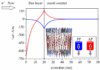
We simulated the current-induced switching of magnetization of short vertical magnetic nanopillars as the free layer in a magnetic tunnel junction. Considering spin accumulation is crucial in such 3D elements, leading to an enhancement of the field-like torque, and the excitation of non-uniform FMR modes. 3D nanomagnetism is a fast-growing topic, motivated by fundamental physical […]
Read moreImprinting of skyrmions and bimerons in an antiferromagnet (October 06th, 2025)
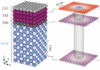
In this work, a consortium of physicists from SPINTEC and York addressed the challenge of nucleating quantitatively proven topological magnetic textures in compensated magnets with zero net magnetization. It paves the way for extending the study of topological spin textures beyond ferromagnets, into materials with intriguing electrodynamic properties, such as antiferromagnets and altermagnets. Topologically […]
Read moreMonolayer control of spin-charge conversion in van der Waals Heterostructures (September 16th, 2025)
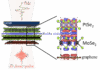
2D materials and van der Waals (vdW) heterostructures are promising candidates to build efficient THz spintronic emitters. Here, we demonstrate the drastic modification of THz spintronic emission by inserting a single layer of MoSe2 in the PtSe2/graphene vdW heterostructure. Ab initio calculations indeed show the emergence of Rashba states due to the electronic hybridization between […]
Read moreMagnetic vortex dynamics probed by time-resolved magnetic helicoidal dichroism (September 12th, 2025)

Time-resolved magnetic helicoidal dichroism (MHD) was successfully used to assess the ultra-fast dynamics of magnetization. This first attempt to use an MHD-based technique was demonstrated on a magnetic vortex structure hosted by a permalloy pacman micropillar (diameter~15nm, thickness~80nm). Micromagnetic simulations allowed to link the features identified in the MHD signal to a process of regeneration […]
Read more