


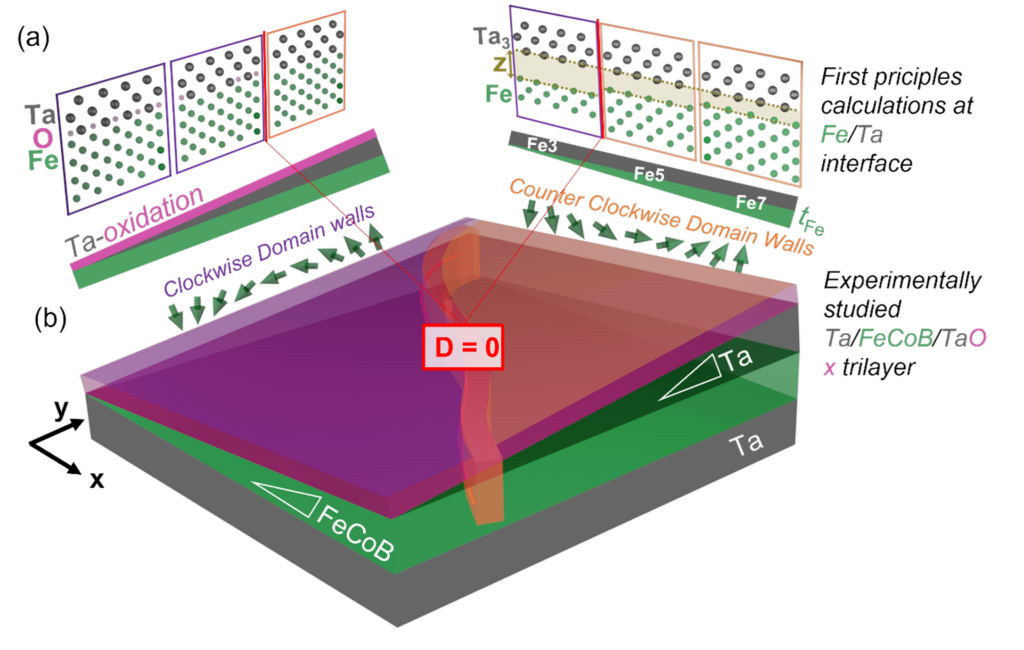
In Ta/FeCoB/TaOx, it was demonstrated that the Dzyaloshinskii-Moriya interaction (DMI) chirality can undergo modification solely in response to variations in the thickness of the ferromagnetic layer. This inversion of chirality is attributed to variations in orbital filling and interatomic distances at the interface, driven by the structural relaxations in the ultrathin regime. This method provides a novel degree of freedom to manipulate the chirality of spin textures by means of strain.

Experimentally studied (Ta/FeCoB/TaOx) double wedge (b) and theoretically analyzed Fe/Ta(Ox) top interface (a). A DMI sign change (D=0, red line) occurs with increasing ferromagnet thickness and decreasing degree of oxidation of the top Ta.
The strength and chirality of the interfacial DMI occurring in ferromagnetic layers at interfaces with heavy metals (HM) or oxides depend on the nature of the HM and on the oxidation state of the oxide. It is generally considered to be the sum of the contributions from the top and bottom interfaces and to vary in strength as the inverse of the ferromagnetic film thickness t. However, no chirality change is expected with t.
Here we showed experimentally that in a Ta/FeCoB/TaOx ultrathin trilayer the magnetic domain walls move under current in opposite directions depending on the FeCoB thickness and TaOx oxidation state. Using magnetooptical Kerr effect microscopy we explored samples with FeCoB thickness gradients in one direction and of TaOx oxidation gradients in a perpendicular direction (see figure). The domain wall motion is due to spin-orbit torque and the observed reversal indicates that domain walls with opposite chiralities (clockwise or counterclockwise). This is a consequence of a change in the DMI chirality. At the transition between the regions with clockwise and counterclockwise chiralities, there is almost no domain wall motion, indicating the presence of a zero DMI line between them. The change in DMI chirality due to the oxidation of the top oxide is well understood in the literature. It is related to the modification of the interface, which leads to a change in the DMI mechanism from the Rashba type (for a more oxidized TaOx) to the Fert-Levy one (for a more metallic TaOx). To elucidate the underlying mechanisms of the observed change in DMI chirality with the ferromagnetic layer thickness, we performed ab initio calculations. The agreement between experimental and theoretical results regarding DMI chirality in relation to both ferromagnet layer thickness and oxidation state enables us to propose unconventional mechanisms governing the DMI chirality. In particular, our calculations show that changes in electronic orbital filling caused by a modified interlayer distance (z) between the ferromagnetic layer and the oxide layers can induce a DMI sign inversion as the number of ferromagnetic monolayers increases. This is directly linked to a strain effect, thereby unlocking exciting opportunities for manipulating chiral domain walls and skyrmions through strain engineering. It is timely that a novel research area is emerging where skyrmions may be nucleated and propagated using transient strain provided by surface acoustic waves.
Teams: Magnetic Sensors, Theory / Simulation, Materials, Instrumentation
Collaboration: Néel Institute (Grenoble, France)
Funding: ANR ADMIS, PEPR-SPIN CHIREX & SPINTHEORY, EU H2020 NUMERICS
Further reading: Dzyaloshinskii-Moriya interaction chirality reversal with ferromagnetic thickness, C. Gueneau F. Ibrahim, J. Fischer, L. Vojáček, C.-É. Fillion, S. Pizzini, L. Ranno, I. Joumard, S. Auffret, J. Faure-Vincent, C. Baraduc, M. Chshiev, and H. Béa, Phys. Rev. B 113, 054416 (2026).
Open access: hal-05371640
Contacts: Hélène Béa, Mairbek Chshiev