
Magnetically driven microparticles provide a versatile platform for probing and manipulating biological systems. Yet the physical framework governing their actuation in complex environments remains only partially explored. In this work, we introduced a simplified model describing the magneto-mechanical response of such particles embedded in viscoelastic media under varying magnetic fields.
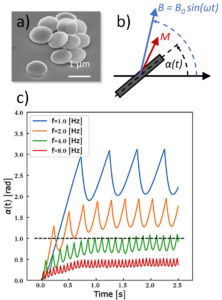
Fig. a) Magnetic vortex micro-disks like the ones that were considered in the calculation. b) Schematics of a particle in a rotating field. B is the applied rotating magnetic field, M is the particle’s magnetization, α(t) characterizes the particle’s orientation. c) Particle’s orientation as a function of time, for different rotating field frequencies, in the asynchronous regime where it oscillates around a given orientation.
For several years now, the Bio/Health team has been studying the magneto-mechanical stimulation of cells using magnetic micro-disks set in motion vibration by remotely applied magnetic fields. The physiological effects induced by the mechanical vibration are diverse, but the most important is undoubtedly the possibility of remotely destroying cancer cells, in a targeted manner.
To better understand the nature of the interaction between the vibrating particles and the host cells, it is essential to understand the dynamics of the particles, taking into account the rheological properties of the intracellular environment. Here, the particle’s motion under rotating magnetic fields was calculated using a Maxwell description of the viscoelastic medium – consisting in a purely viscous damper and a purely elastic spring connected in series – combined with simplified elasticity assumptions. Based on energy consideration taking into account the combined dynamics of the magnetization within the particles and of the particles coupled to the cell, we derived analytical expressions for the particles motion that were supported with numerical simulations.
Despite its simplicity, this model reveals a very rich rotational dynamics of the particles. When viscoelastic stresses are low, the particles’ rotation is synchronous with the rotation of the field. As these stresses increase, a lag between the particles’ rotation and the field’s rotation is initially observed. Beyond a certain threshold, the rotational motion of the particles unhinges from the magnetic field, and a transition occurs to an asynchronous regime where the particles undergo a small amplitude oscillatory motion.
These results are of paramount importance for understanding the effect of the mechanical stimulation on the cell. On the one hand, they illustrate the importance of the viscoelastic properties of the biological medium on rotational dynamics. On the other hand, they highlight the fact that the amplitude of particles motion decreases rapidly as the rotational frequency of the magnetic field increases. For a medium with viscoelastic properties typical of the cellular environment, particles motion is virtually quenched when it exceeds 10 Hz (Fig. c). This result provides an explanation to many experimental observations, where cells response to magneto-mechanical stimulation is larger with lower frequency fields.
Team: Health and biology
Collaborations: CNRS/LTM, PTA
Funding: This work was supported by the French National Research Agency in the framework of the “Investissements d’avenir” program (ANR-15-IDEX-02)
Further reading: Modelling of magnetic vortex microdisc dynamics under varying magnetic field in biological viscoelastic environments, Andrea Visonà, Robert Morel, Hélène Joisten, Bernard Dieny and Alice Nicolas, Nanoscale Advances 8, 1570 (2026).
Open access: hal-05342427v2
Contact: Bernard Dieny