
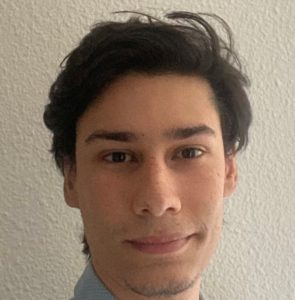
 On September 22th at 14:00, Abderrazak Hakam (SPINTEC) will defend his PhD thesis entitled : Control of the stochastic phase dynamics of spin-torque nano-oscillators for unconventional computing
Place : Spintec, batiment 1005, room 445, 2nd floor
video conference : https://visio.numerique.gouv.fr/hiq-nlrl-apc
Call: (FR) +33 9 79 94 06 78
Code: 723 696 0953#
Abstract : As computational problems grow in size and complexity, solving them in software has become too energy consuming, constrained by the bottlenecks of conventional digital hardware. This motivates unconventional computing architectures such as Ising machines (IMs), which map combinatorial optimization problems onto the Ising Hamiltonian of coupled binary spins. Much like a magnetic material, such an Ising system will relax to its global energy minimum corresponding to the solution of the mapped problem. Hence, exploiting the intrinsic dynamics of physical dynamical systems rather than digital computation, promises large gain in speed and energy efficiency.
An IM can be operated in two schemes: the first is a deterministic one, often used in oscillator-based IMs (OIMs) and memristive crossbar arrays that relies on annealing to escape local energy minima and converge to the global one. The second is a probabilistic one, exploiting noise inherent to the devices themselves, as shown with stochastic magnetic tunnel junctions (SMTJs). The energy landscape is then explored stochastically and the ground state is inferred from the probability distribution. Spin-torque nano-oscillators (STNOs) are an appealing spintronic alternative: compact, CMOS-compatible and frequency tunable. They have been harnessed for a variety of computing tasks and were naturally proposed as nodes of OIMs, where the spin is encoded in the binary phase states set by second-harmonic injection-locking (SHIL).
So far, STNOs have been explored mostly in simulations and in the context of a deterministic scheme. In this thesis we demonstrate how to leverage the intrinsic randomness of the STNO phase, to construct in hardware, a spatial and fully programmable probabilistic IM. The experimental implementation addresses step by step the three building blocks to construct the different terms of the Ising Hamiltonian: controllable stochastic Ising spins, programmable local bias fields and tunable spin coupling.
The first block is a direct consequence of the SHIL, coupled to thermally driven switching of the phase between its binary stable states. We show, using an analogue phase readout circuit, that an STNO under SHIL behaves as an unbiased stochastic Ising spin, a property also leveraged to generate unbiased bitstreams. Biasing this spin is the second challenge, since the symmetry of the binary phases proved to be independent of the properties of both the STNO and the SHIL drive. However, a radio-frequency (RF) bias at the first harmonic, applied either as a current or magnetic field, is shown to break this symmetry, giving a deterministic and continuous control over the phase-state probability distribution via the bias phase and amplitude. Supported by Thiele equation simulations and Arrhenius-like modelling, the STNO Ising spin can therefore be operated as a probabilistic-bit. This not only realizes the local bias-field term of the Ising Hamiltonian, but extends SHIL-driven STNO networks beyond IMs, to invertible logic and probabilistic inference systems.
With a programmable spin secured, the remaining ingredient is the coupling between spins, which must be adjustable in both strength and sign. We demonstrate that coupling through a magnetic field generated by an integrated field line is the best choice and allows for full control of the coupling magnitude and sign, thus completing the building blocks of an STNO-based IM.
These blocks are then assembled, using off-the-shelf RF components, into a platform coupling up to five STNOs through their field lines, on which a three-node STNO-based IM was demonstrated with a confirmed operation as an Ising spin system. Together, these results establish the STNO as a versatile stochastic spin unit, tracing a complete pathway from a single stochastic spin to a fully coupled programmable network. This opens a path beyond binary models, such as Potts or XY models, where the stochastic phase dynamics of STNOs form an attractive avenue.
titre : Contrôle de la dynamique stochastique de la phase des non-oscillateurs spintroniques pour les applications du calcul non-conventionnel.
resumé : La résolution numérique de problèmes de calcul toujours plus grands et complexes est devenue trop énergivore, entravée par les limites intrinsèques de l’électronique numérique classique. Cela motive le développement d’architectures non conventionnelles telles que les machines d’Ising (IM), qui projettent les problèmes d’optimisation combinatoire sur l’hamiltonien d’Ising de spins binaires couplés. Similaire à un matériau magnétique, un tel système relaxe vers son minimum d’énergie global, représentant la solution du problème encodé. Exploiter la dynamique intrinsèque des systèmes physiques plutôt que le calcul numérique promet ainsi un gain important en vitesse et en efficacité énergétique.
Une IM peut fonctionner selon deux configurations. Le premier, déterministe, utilisé dans les IM à oscillateurs (OIM) et les matrices de memristors, repose sur des schémas de recuit pour échapper aux minima locaux et atteindre le minimum global. Le second, probabiliste, exploite le bruit inhérent aux dispositifs, comme avec les jonctions tunnel magnétiques stochastiques (SMTJ). Le paysage énergétique est alors exploré stochastiquement et l’état fondamental est déduit de la distribution de probabilité. Les nano-oscillateurs à transfert de spin (STNO) sont une alternative spintronique attrayante: compacts, CMOS-compatibles et versatiles, ils ont servi à diverses tâches de calcul et ont été proposés comme nœuds d’OIM, où le spin est encodé dans les états de phase binaires fixés par le verrouillage par injection à la seconde harmonique (SHIL).
Jusqu’ici, les STNO ont surtout été étudiés en simulation, dans un cadre déterministe. Dans cette thèse, nous exploitons le caractère aléatoire de la phase du STNO pour construire, en matériel, une IM probabiliste, spatiale et entièrement programmable. La mise en œuvre expérimentale aborde les trois ingrédients de l’hamiltonien d’Ising: des spins stochastiques contrôlables, des champs de biais locaux programmables et un couplage accordable entre spins.
Le premier ingrédient découle du SHIL, associé aux fluctuations thermiquement activées de la phase entre ses deux états stables. Avec un circuit analogique de lecture de phase, nous montrons qu’un STNO sous SHIL se comporte comme un spin d’Ising stochastique non biaisé, propriété aussi exploitée pour générer des flux de bits non biaisés. Biaiser ce spin est un défi, car la symétrie des phases s’est révélée indépendante des propriétés du STNO comme de l’excitation SHIL. Toutefois, un signal radiofréquence (RF) en courant ou en champ magnétique, à la première harmonique, brise cette symétrie. Ce biais offre un contrôle déterministe et continu de la distribution de probabilité des phases via sa phase et son amplitude. Étayé par des simulations d’équations de Thiele et une modélisation suivant une loi d’Arrhenius, le spin d’Ising STNO peut ainsi fonctionner comme un bit probabiliste. Cela réalise le terme de champ de biais local de l’hamiltonien et étend les réseaux de STNO pilotés par SHIL au-delà des IM, vers la logique inversible et l’inférence probabiliste.
Avec le spin programmable acquis, il reste à établir le couplage entre spins, ajustable en intensité comme en signe. Nous avons démontré que le couplage par un champ magnétique via une ligne de champ intégrée est le meilleur choix et permet un contrôle complet de son amplitude et de son signe, complétant les briques d’une IM à base de STNO.
Ces briques sont ensuite assemblées, avec des composants RF du commerce, en une plateforme couplant jusqu’à cinq STNO par leurs lignes de champ; une IM à trois nœuds y a été démontrée. Ces résultats établissent le STNO comme une unité de spin stochastique polyvalente, traçant un parcours allant du spin unique au réseau programmable couplé. Cela ouvre une voie au-delà des modèles binaires, comme ceux de Potts ou XY, où la dynamique de phase stochastique des STNO constitue une piste attrayante.
Jury :
- Julie GROLLIER, DIRECTRICE DE RECHERCHE, CNRS, Rapportrice
- Joo-Von KIM, DIRECTEUR DE RECHERCHE, CNRS, Rapporteur
- Alex JENKINS, CHERCHEUR, International Iberian, Nanotechnology Laboratory, INL, Braga, Portugal, Examinateur
- Florence PODEVIN, Professeure Grenoble INP – UGA, Examinatrice
- Franck Badets, DIRECTEUR DE RECHERCHE, CEA, Invité
- Louis HUTIN, DIRECTEUR DE RECHERCHE, CEA, Invité
Thesis supervisors :
- Ursula EBELS, SPINTEC, Directrice de thèse
- Philippe TALATCHIAN, SPINTEC, co-Encadrant