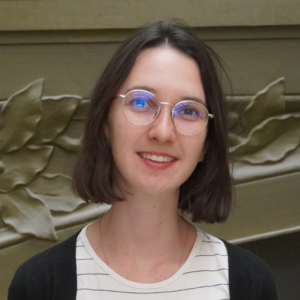
 On December 9th at 9:00, Coline THEVENARD (SPINTEC) will defend her PhD thesis entitled : Unconventional topological spin textures in spintronics
Place : IRIG/SPINTEC, CEA Building 10.05, auditorium 445 (presential access to the conference room at CEA in Grenoble requires an entry authorization, request it before November 25th to admin.spintec@cea.fr)
video conference : https://visio.numerique.gouv.fr/hvg-fihh-mch
title : Unconventional topological spin textures in spintronics
Abstract : Topological textures in compensated magnets have attracted significant attention for their rich spin physics and potential as ultrafast particle-like carriers of information in spintronic technologies, combining topological protection with vanishing net magnetization. Antiferromagnetic skyrmions and bimerons are particularly appealing in this context. However, their controlled nucleation remains a major challenge. This thesis demonstrates that texture imprinting from a ferromagnet provides an efficient route for the nucleation and control of such topological states in compensated magnets. Using atomistic spin simulations, we first establish thermomagnetic imprinting into a prototypical bipartite collinear antiferromagnet, the persistence of topological textures in the decoupled antiferromagnet and the reverse imprint into a saturated soft ferromagnet. This approach enables the quantitative characterization of the imprinted textures through their topological parameters. We then demonstrate ultrafast antiferromagnetic skyrmion imprint using femtosecond laser excitation, and identify the interplay between the magnetic parameters, excitation conditions, and applied magnetic field that govern the topology and stability of the resulting textures. Finally, we extend the imprinting mechanism to the technologically relevant multipartite antiferromagnet IrMn₃, combining atomistic simulations with experiments on (NiFe/Co)/Pt/IrMn₃ heterostructures to quantify the role of the Pt spacer in the imprinting process. These results establish imprinting as a versatile strategy for the controlled generation of topological textures in compensated magnets and provide a framework for the investigation of their ultrafast dynamics and spin-transfer phenomena. The envisioned extension to altermagnets could further combine the robustness and ultrafast, terahertz dynamics of antiferromagnets with enhanced electrical readout arising from their spin-split electronic structure.
titre : Textures de spin topologiques non-conventionnelles pour la spintronique
résumé : Les textures topologiques dans les matériaux magnétiques compensés suscitent un intérêt croissant en raison de leur riche physique de spin et de leur potentiel en tant que porteurs d’information ultrarapides, de nature quasi particulaire, pour les technologies spintroniques. Elles combinent notamment une protection topologique avec une aimantation nette nulle. Les skyrmions et bimérons antiferromagnétiques sont particulièrement prometteurs dans ce contexte. Cependant, leur nucléation contrôlée demeure un défi majeur. Cette thèse démontre que l’impression de textures magnétiques à partir d’un ferromagnétique constitue une voie efficace pour la nucléation et le contrôle de tels états topologiques dans les matériaux magnétiques compensés. À l’aide de simulations atomistiques, nous établissons dans un premier temps l’impression thermomagnétique dans un antiferromagnétique colinéaire bipartite prototypique, la préservation de la texture topologique dans l’antiferromagnétique découplé et l’impression inverse vers un ferromagnétique doux saturé. Cette approche permet de caractériser quantitativement les textures imprimées à travers leurs paramètres topologiques. Nous démontrons ensuite l’impression ultrarapide de skyrmions antiferromagnétiques à l’aide d’une excitation laser femtoseconde, et identifions l’interaction entre les paramètres magnétiques, les conditions d’excitation et le champ magnétique appliqué qui gouvernent la topologie et la stabilité des textures obtenues. Enfin, nous étendons le mécanisme d’impression à l’antiferromagnétique multipartite technologiquement pertinent IrMn₃, en combinant des simulations atomistiques et des expériences sur des hétérostructures NiFe/Co/Pt/IrMn₃ afin de quantifier le rôle de l’espaceur de Pt dans l’impression. Ces résultats établissent l’impression de textures comme une stratégie possible pour la génération contrôlée de textures topologiques dans les matériaux magnétiques compensés et fournissent un cadre pour l’étude de leur dynamique ultrarapide et des phénomènes de transfert de spin. L’extension envisagée aux altermagnétiques pourrait associer la robustesse et la dynamique ultrarapide térahertz des antiferromagnétiques à une lecture électrique facilitée par leur structure électronique à bandes polarisées en spin.
Jury :
- Denis Ledue – PROFESSEUR DES UNIVERSITES, Université de Rouen-Normandie – Rapporteur
- Joo-Von Kim – DIRECTEUR DE RECHERCHE, CNRS – Rapporteur
- Mara Strungaru – MAITRESSE DE CONFERENCES, University of Manchester – Examinatrice
- Laurent Ranno – MAITRE DE CONFERENCES, Université Grenoble Alpes – Examinateur
- André Thiaville – DIRECTEUR DE RECHERCHE, CNRS – Examinateur
Thesis supervisors :
- Vincent Baltz – DIRECTEUR DE RECHERCHE, CNRS – Directeur de thèse
- Daria Gusakova – CHARGEE DE RECHERCHE, CNRS – Co-encadrante de thèse
- Richard F. L. Evans – PROFESSEUR DES UNIVERSITES, University of York – Co-encadrant