
 On February 16th, we have the pleasure to welcome in SPINTEC Hebatalla Elnaggar from Sorbonne-Univerité. She will give us a seminar at 11:00 entitled : Magnetic excitations beyond single-magnons
Place : IRIG/SPINTEC, auditorium 445 CEA Building 10.05 (presential access to the conference room at CEA in Grenoble requires an entry authorization. Request it before February 5th at admin.spintec@cea.fr)
video conference : https://visio.numerique.gouv.fr/ouk-ofdi-ydu
Abstract : Antiferromagnets and altermagnets host terahertz magnons with nanometre wavelengths, making them promising platforms for high-frequency magnonics. Accessing these short-wavelength excitations with light, however, is challenging because optical photons carry very little momentum. Multimagnon processes offer a way around this mismatch: several magnons with large individual momenta can be created together while their total momentum remains small [1,2,3]. This opens a route to optical excitation of THz spin dynamics—but how many magnons can light create in a single scattering event?
Resonant inelastic X-ray scattering (RIXS, shown in Fig. 1a) offers a powerful way to explore this question. By measuring the energy and momentum transferred as X-rays scatter from a material, RIXS resolves magnetic excitations, while resonant enhancement makes otherwise weak higher-order processes accessible. A simple angular-momentum argument suggests that this two-photon process should produce, at most, two spin flips. Strikingly our measurements on α-Fe₂O₃ reveal a triple-magnon excitation, alongside signatures of four- and five-magnon processes as can be seen in shown in Fig. 1b [1,2]. I will discuss how coupling between spin, orbital and lattice degrees of freedom allows the lattice to act as an angular-momentum reservoir, opening channels beyond conventional expectation.
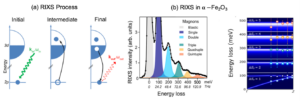
Figure 1: (a) Schematic of Resonant Inelastic X-ray Scattering (RIXS). (b) Fe 2p3d RIXS measured in -Fe2O3 single crystal where we observed multi-magnons and their dispersion.
However, the nearly flat multimagnon features raise another fundamental question about their microscopic nature. Flat spectra are commonly associated with localisation—but can they instead conceal propagating spin waves? To resolve this ambiguity, we use temperature as an additional spectroscopic handle. Through momentum- and temperature-dependent RIXS on LaCrO₃, we thermally populate the magnon band and thereby activate annihilation channels absent at low temperature. We resolve an anti-Stokes single-magnon branch and a mixed three-magnon channel in which two magnons are created while a third is annihilated [3]. Their energy and momentum dependence reveals that the apparently flat multimagnon features are assembled from propagating magnons.
Beyond revealing the microscopic origin of multimagnon excitations, these results establish RIXS as a probe of higher-order THz spin dynamics. This opens a route towards investigating magnon–magnon interactions and scattering processes relevant to high-frequency magnon transport in thin films, heterostructures and device-like environments.
- Elnaggar et. al., Nat. Commun., 14, 2749, 2023
- Li et al., Phys. Rev. X, 13, 011012, 2023, [3] M. Lazemi et al., arXiv:2609.14792 [cond-mat.str-el]
Biography : Hebatalla Elnaggar obtained her PhD from Utrecht University, the Netherlands, and held a two-year Rubicon postdoctoral fellowship at Sorbonne University in Paris, France, before becoming a CNRS researcher there. She currently leads the Young Investigator Group “Magnons: X-rays and Models” at Helmholtz-Zentrum Berlin, Germany, investigating magnetic excitations using X-ray spectroscopy and microscopic modelling.