
Angular momentum (AM) is the conserved quantity associated with rotational invariance. Harnessing its orbital component in axi-symmetric sample is often challenging. Interestingly, we show that azimuthal spin waves in normally magnetized disks are largely immune to imperfections that would otherwise prevent the wavefront from orbiting around the disk.
* “And yet it moves!” is the exclamation attributed to the Italian astronomer Galileo Galilei (1564–1642), on the realization that celestial motion could be easily understood from the perspective of an observer located on a spinning Earth orbiting around the Sun.
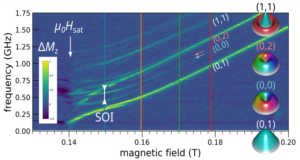
Evolution with an external magnetic field of the SW spectra in a normaly magnetized disk. Modes are labeled by (nR,nJ) respecively their radial and orbital index nJ = nL+nS. SOI shows the splitting between modes of opposite OAM nL=±1.
The fundamental importance of angular momentum (AM) conservation in solids has long been recognized as a powerful means to encode information, with the widely studied spin component carried by conduction electrons representing only part of the story. The same concept applies to spin-waves (SW) propagating in normally magnetized cylinders, whose dynamics can be described as circularly polarized vector fields with helical or rotating wavefronts. In this context, AM can be decomposed into spin (SAM) and orbital (OAM) components. Whereas SAM can take only two values, corresponding to the polarity of circular precession, OAM can take any positive or negative integer value. This has always attracted significant attention. i) In the quantum regime, the OAM degree of freedom enables the encoding of arbitrarily large multiples of ℏ. ii) In the classical regime, modes carrying different OAM propagate independently with minimal interference due to their orthogonality, enabling increased information transfer via mode-division multiplexing.
Exploiting the OAM of magnons first requires establishing that the wavefront of SW in axially symmetric sample is truly rotating rather than stationary. This question is relevant because small deviations from rotational invariance often couple modes with opposite AM indices. For spin waves, however, we experimentally observe a large energy splitting between modes of opposite OAM, as shown in the enclosed figure. This splitting originates from a spin–orbit interaction (SOI) arising from dynamical dipole–dipole interactions: the dynamic stray magnetic field generated by the wave. The splitting exceeds the linewidth by several orders of magnitude, making the rotating nature of the wavefront robust against structural imperfections. The fact that the SOI splitting depends on the applied magnetic field fully rules out a static imperfection-induced origin.
The next step is to pass on the OAM of the spin-wave to other vector fiels such as phonon or photons.
Teams: Spin Insulatronics
Collaborations: CEA and JAEA
Funding: EU-Project No. HORIZON-EIC-2021-PATHFINDER OPEN PALANTIRI-101046630; the French Grant No. ANR-21-CE24-0031 Harmony; the PEPR SPIN-MAGISTRAL Grant No. ANR-24-EXSP-0004; the French Renatech network; and the REIMEI Research Program of Japan Atomic Energy Agency
Further reading: «Orbital angular momentum of azimuthal spin waves» (doi:10.1103/l1x7-t8pn) and «Field theory of linear spin waves in finite textured ferromagnets» (doi:10.1103/qyr8-9817) Open access: cea-05003501v1 and cea-05003507v1
Contact: Olivier Klein