
Magnetic field sensors are widely used for contactless current measurement, as well as in the automotive and robotics industries for position encoding. Vortex sensors are particularly attractive for these applications because of their linear response and weak temperature dependence. Conventional vortex sensors are sensitive to magnetic fields applied in the sensor plane. We developed a new type of vortex sensor sensitive to out-of-plane fields, exhibiting lower noise and improved signal-to-noise ratio compared with in-plane vortex sensors. These new sensors are especially promising for contactless current sensing and 3D magnetic-field sensing.
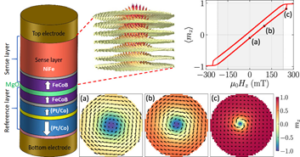
Figure: Magnetic tunnel junction comprising a vortex sense layer of thickness comparable to diameter and detail of its micromagnetic configuration. Transfer curve showing the linearity of the sensor with two branches corresponding to the out-of-plane orientation of the vortex core (up or down). (a)-(c), top view evolution of vortex configuration under magnetic field showing the variation in core diameter and out-of-plane polarization of the magnetization. Color code=out-of-plane component of magnetization.
Cylindrical ferromagnetic layers often exhibit at zero field a vortex micromagnetic configuration consisting of an in-plane magnetization curling around the cylinder center and a vortex core magnetized out-of-plane. This micromagnetic configuration evolves under applied magnetic field. When the field is applied in-plane, the vortex core shifts laterally transverse to the field direction yielding a net in-plane magnetic polarization along the field direction. Common in-plane sensitive vortex sensors integrate such a vortex layer with an in-plane reference layer in a magnetic junction. These sensors are robust, weakly dependent on the operating temperature and are widely used as position encoders in robotics or automotive industry. However, they exhibit significant noise due to trapping and untrapping of their very small vortex core (core diameter~5nm) on local defects as the core moves radially under magnetic field.
In the present study, we developped another type of vortex sensor sensitive to out-of-plane field. Unlike their in-plane-sensitive counterparts, the aspect ratio of their vortex magnetic layer (thickness/diameter) is here much closer to 1 (thickness~60nm, diameter~100nm compared to thickness~50nm, diameter~1mm for vortex sensors sensitive to in-plane field). Consequently, the balance between exchange energy and demagnetizing energy governing the vortex configuration is drastically modified. As a result, the vortex core is larger and its diameter varies significantly under out-of-plane applied field (see Figure). Combined with an out-of-plane polarization of the vortex magnetization, this produces a strong out-of-plane variation of the vortex magnetization under out-of plane field. The vortex layer is then integrated in a magnetic tunnel junction with an out-of-plane reference layer. Since vortex core expansion/contraction and out-of-plane polarization of the magnetization are much more reversible processes than lateral motion of the vortex core in in-plane vortex sensors, these devices exhibit lower noise and improved signal-to-noise ratio. These sensors are very promissing for current sensing particularly in battery-management applications.
Team: MRAM
Collaborations: PTA, sensors team
Funding: This work was supported by the ERC PoC project Nanosense
Further reading: Low-Noise Nanoscale Vortex Sensor for Out-of-Plane Magnetic Field Detection, Ajay Jha, Alvaro Palomino, Stéphane Auffret, Hélène Béa, Ricardo C. Sousa, Liliana D. Buda-Prejbeanu, O. Fruchart, B. Dieny, ACS Nano 20, 6644−6654 (2026).
Open access: hal-05516294
Contact: Bernard Dieny