
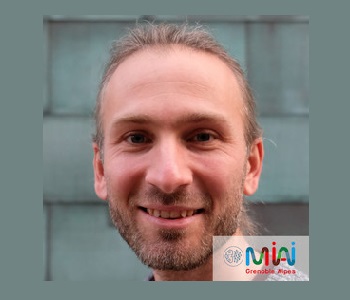
 On July 8th, 2026 we have the pleasure to welcome in SPINTEC Dr. Martin UHRIN from The MIAI Cluster (Multidisciplinary Institute in Artificial Intelligence). He will give us a seminar at 11:00 entitled:
Elevating Atomistic Machine Learning: From Physics-Informed Structural Models to the Electronic and Spin Frontier.
Place: IRIG/SPINTEC, auditorium 445 CEA Building 10.05 (presential access to the conference room at CEA in Grenoble requires an entry authorization).
video conference : https://univ-grenoble-alpes-fr.zoom.us/j/98769867024
Meeting ID: 987 6986 7024
Passcode: 025918
Abstract: In my team, we develop physics-informed machine learning models for atomistic systems, where our goal is to push out as much of the “black-boxiness” of generic AI models as possible and maintain as many of the physical laws and relationships that we know cannot be violated. The advantage of this approach is two-fold: it makes our models inherently more interpretable, while simultaneously imbuing them with high data-efficiency, meaning we can make high-fidelity predictions using far smaller datasets.
To date, much of the work within both my team and the community at large has relied on models that treat atomic positions and chemical species as the sole inputs. While this structural focus greatly simplifies the learning task, it neglects the underlying electronic degrees of freedom. By explicitly accounting for electrons, we can not only improve the baseline accuracy of atomistic models, but also open the door to entirely new classes of material properties that rely on electrons—and notably their spin—to enable next-generation technologies.
In this talk, I will first demonstrate how we introduce strict physical constraints, such as spatial equivariance and conservation laws, into our existing architectures to learn complex physical observables. I will then highlight our recent directions in introducing explicit degrees of freedom meant to capture electronic structure directly, such as learning Hubbard interaction parameters from shifting electronic occupations. Finally, I will offer prospectives on how this framework can be extended to spintronics. By showcasing what is possible when physics is baked into AI, I hope to inspire a discussion on how we can collaborate to map the specific symmetries, relativistic effects, and interfacial phenomena of spintronics onto this framework.
Biography: Martin Uhrín holds the MIAI International Research Chair at Université Grenoble Alpes, where he leads a team developing physics-informed machine learning methods to accelerate materials modelling and enable the inverse design of materials and molecules. He earned his PhD in Computational Condensed Matter Physics from UCL under Chris Pickard, before two postdoctoral appointments at EPFL with Nicola Marzari—where he was lead author of the AiiDA workflow engine—and a further postdoc at the Technical University of Denmark working on high-throughput discovery of battery materials. He returned to EPFL as a scientist from 2021 to 2023, focusing on physics-inspired machine learning for property prediction and inverse design. His current research centers on equivariant neural networks and generative models that embed physical symmetries and conservation laws directly into AI architectures, with recent work extending these methods to learn electronic structure properties such as Hubbard interaction parameters, opening pathways toward spin-dependent materials phenomena. He is a developer of the e3nn framework and associate editor of AI for Science.