
3D nanomagnetism is a field of rising importance, with physics arising specifically thanks to curvature and 3D magnetization distributions. Here, we report experimentally the delay of Walker breakdown for domain-wall motion, resulting from the stabilizing exchange of peripheral domain walls with longitudinal magnetization on the axis. Simulations also suggest a giant non-reciprocal effect related to curvature.
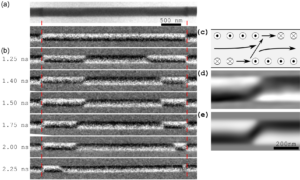
Left: (a) Structure of the wire, two chemical modulations helping to pin domain walls (b) Wall displacement versus the duration of the current pulse. Right: (c) Cross-section sketch of the vortex domains and the domain wall (d) Experimental and (e) simulated contrast for such a domain wall coincide.
Cylindrical wires are a textbook situation for 3D nanomagnetism, thanks to their translation and rotational geometrical invariance. It has been predicted since the 2000’s that the dynamical instability of domain walls limiting their speed, known as Walker breakdown, may be delayed in these. In these so-called Bloch-point domain walls separate oppositely-magnetized domains, which set a large cost for instabilities. Accordingly, field- and current-driven speeds as large as 1 km/s have been predicted, with encouraging experimental results. Besides, more recently curvature has been predicted to give rise to a number of effects, such as effective magnetic anisotropy or Dzyaloshinskii-Moriya interaction, or the non-reciprocal propagation of spin waves.
We consider the unusual situation of 200 nm-diameter, Fe20Ni80 vortex-state wires, i.e., magnetization longitudinal on the axis and azimuthal at the periphery. Between two domains with opposite circulation is a domain wall, addressed by the azimuthal Œrsted field arising when an electric current is fed into the wire. The wall displacement upon sending current pulses is proportional to their duration, from which we derive the speed 200 m/s. Simulations reveal a mixed Bloch/Néel character for walls at rest, spontaneously breaking the rotational symmetry. During motion the wall cannot precess freely due to its exchange-spring coupling with the wire axis: a Walker process is initiated with the nucleation of a pair of surface vortex/antivortex, but it is not complete. Depending on relative circulation of the domain with respect to the direction of wall motion, this gives rise to either a low-mobility steady-state regime, or high-mobility regime involving periodic transformations of the vortex polarities, a manifestation of non-reciprocity induced by curvature.
These results have been obtained in the framework of a key partnership between SPINTEC and the Universidad Complutense de Madrid, who masters the electrochemical synthesis of these wires. This illustrates the unusual physics of 3D nanomagnetism, with steady-state low-mobility walls and large-mobility walls with periodic transformations, opposite to the one-dimensional model. Understanding these features is important before envisioning developing 3D technologies such as the magnetic race-track memory.
Teams: Spin Textures, Theory and simulation
Collaboration: Universidad Complutense de Madrid, University of Salamanca, Institut Néel
Funding: ANR DiWiNa
Further reading: Non-reciprocity and exchange-spring delay of domain-wall Walker breakdown in magnetic nanowires with azimuthal magnetization, L. Gomez-Cruz, …, O. Fruchart, L. Perez, Phys. Rev. B 144, 134425 (2026).
Open access: hal-05537298
Contact: Olivier Fruchart