Overview
The Magnetic Random Access Memories (MRAM) group develops advanced concepts in this emerging technology. The goal is to realize cells with improved thermal stability, lower power consumption and/or faster switching. Our research covers material stack deposition, nano-fabrication and electrical test evaluation, for applications as standalone memory and non-volatile logic and more recently in neuromorphic computing architectures.
Research directions
Perpendicular Anisotropy Materials
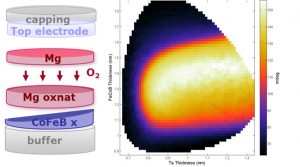
High energy barriers for spin transfer torque (STT) MRAM cells can be achieved with perpendicular anisotropy magnetic tunnel junctions. Solutions for high density MRAM cells to diameters below 20nm require continuous improvements in perpendicular surface anisotropy, while maintaining high TMR properties.
Perpendicular STT MRAM
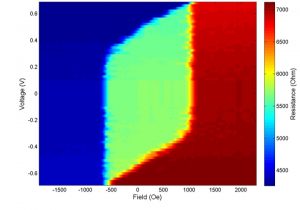
Evaluation of MRAM concepts requires simulation of expected reversal mechanisms and electrical characterization of individual cells. We aim at understanding dynamics of magnetization reversal and the expected impact of stack modifications to explore application specific optimizations.
Nanofabrication Challenges
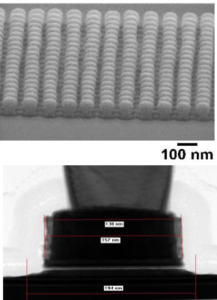
Innovation on dense MRAM using pre-patterned substrates, CMOS integration of multifunctional cells and sub-10nm lateral sizes. Tunnel junction nanofabrication in our platform is essential to evaluate MRAM concepts and performance.
Perpendicular Shape Anisotropy
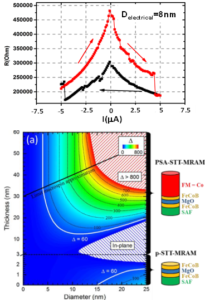
A solution for sub-10nm cell sizes uses high aspect ratios to generate perpendicular shape anisotropy providing scalable retention at the smallest cell sizes. Spin transfer torque switching is possible in these cells, where the reversal dynamics is now under study.
The team















Former members
Post-docs
- Andrey TIMOPHEEV (2014-2017)
- Van Dai NGUYEN (2016-2018)
- J. Ranier Roiz (2015-2016)
- Nikita Strelkov (2016-2019)
PhD
- Luc TILLIE (2015-2018)
- Nicolas PERRISSIN (2015-2018)
- Jyotirmoy CHATTERGEE (2014-2017)
- Hieu Tan NGUYEN (2013-2016)
- Antoine Chavent (2013-2015)
Process Engineers
- Jude GUELFFUCCI (2015-2017)
- Nathalie LAMARD (2016-2017)
- Guillaume LAVAITTE (2015-2016)
Projects
- Samsung SGMI (2014-2017)
- ANR Excalyb (2014-2017)
- Heumem (2015-2018)
- EU-FET Spice (2016-2019)
- EU Great (2016-2019)
- ERC Magical (2015-2020)
Partners
- CEA LETI, Grenoble, France
- Institut NEEL, Grenoble, France
- Crocus Technology, Grenoble, France
- Samsung, San Jose, USA
- Singulus AG, Kahl am Main, Germany
- Aarhus University, Aarhus, Denmark
- Radboud Universiteit, Neijmegen, Netherlands
Recent news
- PhD Defense – Adressing bottlenecks in fabrication and reading and writing procedures for Perpendicular Shape Anisotropy Spin Transfer Torque Magnetic Random Access Memories (October 01st, 2026)

On November 17th at 14:00, Natalia BOSCOLO MENEGUOLO (SPINTEC) will defend her PhD thesis entitled : Adressing bottlenecks in fabrication and reading and writing procedures for Perpendicular Shape Anisotropy Spin Transfer Torque Magnetic Random Access ... - Low-Noise Nanoscale Vortex Sensor for Out-of-Plane Magnetic Field Detection (June 30th, 2026)
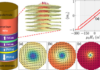
Magnetic field sensors are widely used for contactless current measurement, as well as in the automotive and robotics industries for position encoding. Vortex sensors are particularly attractive for these applications because of their linear response ... - PhD Defense – Perpendicular anisotropy interfaces for high-efficiency low power spintronics (June 01st, 2026)

On July 07th at 14:00, Hanna Karaoui (SPINTEC) will defend her PhD thesis entitled: Perpendicular anisotropy interfaces for high-efficiency low power spintronics Place : IRIG/SPINTEC, CEA Building 10.05, auditorium 445 (presential access to the conference room ... - PhD Defense – Exploration of orbital-to-spin conversion materials and integration in 3-terminal spin-orbit torque magnetic tunnel junctions (May 06th, 2026)

On June 19th 2026 at 14:00, Marco Biagi (SPINTEC) will defend his PhD thesis entitled : Exploration of orbital-to-spin conversion materials and integration in 3-terminal spin-orbit torque magnetic tunnel junctions Place : IRIG/SPINTEC, CEA Building 10.05, ... - seminar – Designing High-Efficiency Spin-Orbit Torque Materials: From β-W Alloy Engineering to Low-Power MRAM Switching (April 13th, 2026)

On Friday April 24th, we have the pleasure to welcome in SPINTEC Prof. Young Keun KIM from Department of Materials Science and Engineering, Korea University. He will give us a seminar at 9:00 entitled : ...